
Do Shutters Reduce Noise? What Suffolk Homeowners Need to Know
Updated: Jun 15

Noise reduction is a buying motivation that does not feature prominently in most shutter guides — but it is a genuine and measurable benefit that is relevant to a significant number of Suffolk homeowners.
Road noise in Bury St Edmunds and Woodbridge town centres. Coastal wind noise in Southwold, Aldeburgh and Walberswick. Agricultural noise in rural Suffolk. The low-frequency hum of traffic on major roads adjacent to residential areas throughout the county — these are all genuine acoustic challenges for Suffolk homeowners, and shutters address them to a meaningful degree.
This guide from Miavalentina Interiors explains honestly what shutters can and cannot do for noise reduction, where the benefit is greatest and what to expect from a shutter installation if noise is one of your primary motivations.
Do shutters reduce noise?
Yes — closed hardwood shutters provide a measurable reduction in external noise levels, primarily by creating an additional barrier at the window that absorbs and reflects sound energy before it enters the room. The noise reduction benefit is most significant for lower-frequency sounds — road traffic, wind noise, agricultural machinery — and less effective for higher-frequency sounds. Shutters are not soundproofing and do not eliminate external noise, but they consistently make rooms noticeably quieter when closed, particularly in properties with single-glazed windows where the window is the primary acoustic weak point.
How shutters reduce noise — the acoustic mechanism
Sound travels as pressure waves through the air and through solid materials. When sound waves encounter a solid barrier — a wall, a window, a closed shutter panel — some of the energy is reflected, some is absorbed by the material and some is transmitted through it. The proportion of energy reflected and absorbed versus transmitted determines how much sound reduction the barrier provides.
A closed hardwood shutter panel adds an additional solid barrier between the external noise source and the room interior. The air gap between the shutter and the window glass — the same gap that provides thermal insulation — also provides acoustic insulation, as the still air gap is an effective sound absorber for lower-frequency waves. Read our full guide on whether shutters are good for insulation for the complete thermal performance picture.
The combined effect of the shutter panel and the air gap is a measurable reduction in transmitted sound energy. The exact reduction depends on the frequency of the sound, the mass of the shutter panel and the depth of the air gap — but for the lower-frequency sounds that cause the most discomfort in domestic environments, the reduction is typically between three and eight decibels. A three decibel reduction is perceptible as a noticeable quietening. An eight decibel reduction represents roughly half the perceived loudness.
This is not dramatic soundproofing — a specialist acoustic secondary glazing installation can achieve fifteen to twenty decibel reductions. But it is a real and consistently noticed benefit, particularly in rooms where the existing window has poor acoustic performance.

Where the noise reduction benefit is greatest
The noise reduction benefit of shutters is greatest in specific situations — understanding these helps you assess whether noise reduction is a meaningful benefit in your specific case.
Single-glazed windows — The acoustic performance of a single pane of glass is very poor. Single-glazed windows in period properties throughout Suffolk transmit a high proportion of external sound energy into the room. A closed shutter panel adds a meaningful additional barrier over a single-glazed window, and the air gap between the shutter and the single pane provides additional absorption. The benefit is proportionally greater than over double glazing because the baseline acoustic performance of single glazing is so much lower.
Town centre properties facing busy roads — Properties in Bury St Edmunds and Woodbridge town centres where the window faces a road with regular traffic experience a consistent low-frequency noise source that shutters address well. The mass and density of the Paulownia hardwood panel reflects lower-frequency traffic noise more effectively than lighter materials.
Coastal properties facing wind — Wind noise — the sound of wind passing the window frame and around the building — is a consistent issue in coastal properties across Southwold, Aldeburgh and Walberswick. Our complete guide to shutters for seaside homes covers all the considerations specific to coastal Suffolk properties. Closed shutters reduce the sound of wind passing the window by creating an additional layer that absorbs and reflects the sound energy before it reaches the glazing and enters the room.
Rural properties near agricultural activity — Farm machinery, livestock and the general acoustic character of an active agricultural landscape generate low-frequency noise that carries over significant distances. In rural Suffolk properties where these sounds are a nightly or seasonal presence, shutters provide a meaningful reduction that makes bedrooms and living rooms noticeably quieter.
Properties with draughty original sash windows — Original sash windows in Victorian and Georgian properties are often imperfectly sealed — the sash mechanism allows some air infiltration around the sashes, and this air movement carries sound directly into the room. Our complete guide to shutters for sash windows covers the full range of benefits shutters provide on this window type. Closed shutters partially mitigate this by reducing the air movement behind the shutter that would otherwise amplify the sound transmission through the draughty frame.

What shutters cannot do for noise reduction
It is important to be honest about the limitations of shutters as an acoustic solution.
Shutters are not specialist acoustic treatment. They do not eliminate external noise. They do not provide the level of noise reduction achieved by secondary glazing, acoustic laminated glass or specialist acoustic wall construction — all of which can achieve significantly greater reductions at higher cost.
For very high noise levels — a property directly adjacent to a major road, adjacent to a railway line or beneath a flight path — shutters will make a noticeable difference but will not make the room quiet. Specialist acoustic glazing solutions are the appropriate treatment for extreme noise environments.
For higher-frequency sounds — voices, music, specific mechanical tones — shutters provide less benefit than for lower-frequency traffic and wind noise. The mass of the shutter panel and the depth of the air gap are more effective at absorbing and reflecting lower frequencies than higher ones.
Shutters also only provide noise reduction when closed. An open shutter — or a shutter with louvres open — provides no acoustic benefit beyond the window itself. The noise reduction benefit is a function of the closed shutter and the sealed air gap it creates.
Shutters and draughts — the indirect acoustic benefit
There is an indirect acoustic benefit of shutters that is worth noting. The air gap created by a closed shutter reduces draughts through the window frame — and draughts are a significant carrier of sound as well as cold air.
In an original Victorian sash window with a slightly loose sash mechanism, the draught that enters around the sashes carries ambient sound from outside into the room — the sound of traffic, voices, wind — at a level that the glass itself does not transmit. A closed shutter that reduces the draught also reduces this sound pathway, contributing to the overall quietening of the room beyond the direct acoustic barrier effect.
Read our related guide on whether shutters make noise in the wind — a different question with an equally important answer.
This draught-reduction acoustic benefit is in addition to the direct noise reduction provided by the shutter panel and the air gap, and it is most significant in the older period properties of Suffolk where original sash frames are the primary sound transmission pathway rather than the glass itself. For a complete guide to shutters in period homes read our room by room guide for Suffolk period properties.

Combining shutters with other noise reduction measures
For homeowners where noise is a primary concern rather than a secondary benefit, shutters work best as part of a broader approach rather than as a standalone solution.
Secondary glazing combined with shutters — Secondary glazing installed inside the existing window, with shutters fitted in front of the secondary glazing, provides significantly better noise reduction than either measure alone. The two air gaps — one between the original window and the secondary glazing, one between the secondary glazing and the shutter — combine to provide effective acoustic insulation. This is the combination we would recommend for properties where noise reduction is the primary motivation.
Draught proofing combined with shutters — Sealing the draught pathways in original sash windows before fitting shutters eliminates the sound-carrying draught pathway and increases the acoustic effectiveness of the shutters. Draught proofing of sash windows is relatively inexpensive and the combination with shutters produces better acoustic results than shutters alone.
Acoustic seals on shutter frames — Where noise reduction is a specific requirement, acoustic seal tape can be applied to the shutter frame to improve the seal between the frame and the reveal, reducing the flanking sound transmission around the panel edges. This is a specialist option that we can discuss at the survey stage for properties where noise is a primary concern. Read our complete dedicated guide to acoustic shutters in Suffolk for a full breakdown of specification, performance and property types.
The honest verdict
Shutters reduce noise meaningfully — particularly lower-frequency noise in properties with single-glazed windows or draughty original frames. The benefit is noticeable and consistently valued by the homeowners in whose properties we fit them. In the specific contexts of town centre road noise, coastal wind noise and rural agricultural noise in Suffolk, shutters make rooms quieter in a way that is immediately and appreciably felt.
They are not specialist acoustic treatment and will not satisfy homeowners with extreme noise problems. For those homeowners, secondary glazing is the appropriate primary solution and shutters can be added as a complementary measure.
For the majority of Suffolk homeowners where noise is a factor in their daily comfort but not an extreme problem, shutters provide a meaningful improvement that adds to the overall case for fitting them alongside the light control, privacy, insulation and aesthetic benefits they also provide.
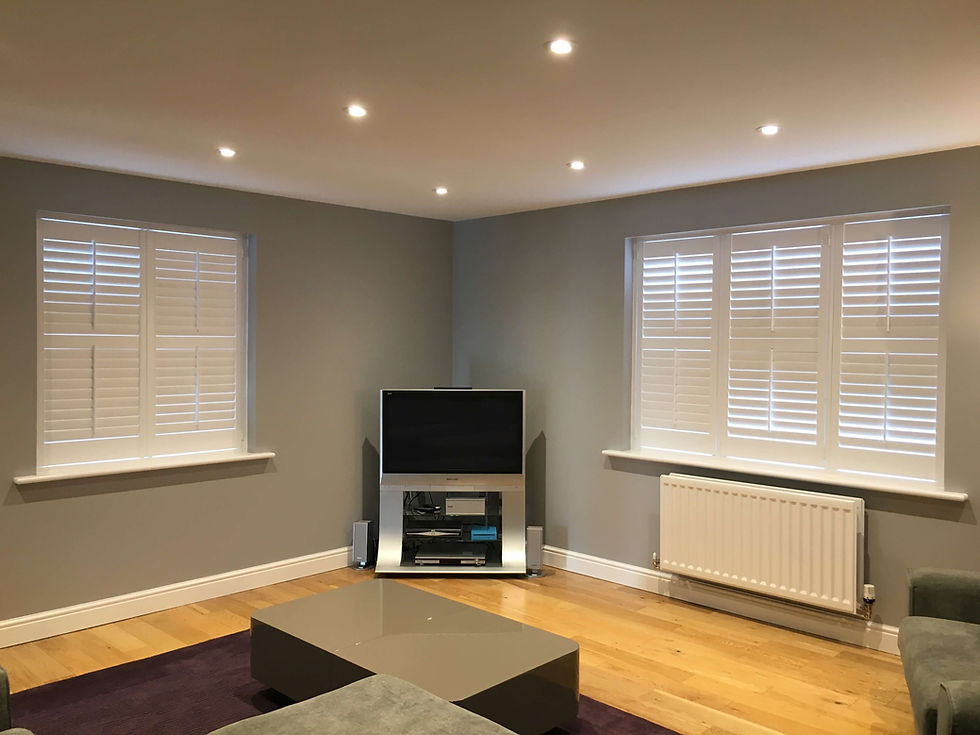
Acoustic Shutters for Windows
Acoustic shutters for windows are one of the most effective passive noise reduction solutions available for domestic properties — and hardwood shutters, when correctly specified and precisely fitted, deliver acoustic performance that most homeowners do not expect from a window treatment.
The term acoustic shutters covers a range of products — from specialist commercial acoustic panels to standard interior shutters fitted in a domestic context. For Suffolk homeowners the relevant question is not whether to buy a specialist acoustic product but whether a well-fitted hardwood shutter will make a meaningful difference to the noise levels in their home. The answer is consistently yes — with some important qualifications about what shutters can and cannot achieve.
Shutters reduce noise through two mechanisms. The first is the physical barrier of the panel itself — a solid or louvred hardwood panel placed between the noise source and the room adds mass to the window assembly, and mass is one of the primary factors in acoustic performance. The second is the elimination of gaps — a precisely fitted hardwood shutter frame seals the reveal edges where draughts and sound enter most readily in older properties. It is often the gap-sealing effect rather than the panel mass that makes the most noticeable difference in period Suffolk properties with older window frames.
For the best acoustic performance from a hardwood shutter installation the specification should prioritise tight frame fit, minimal gaps around the panel perimeter and — where complete noise reduction is the primary objective — solid panel shutters rather than louvred panels. Read our full guide on solid panel shutters and noise reduction below.
Solid Panel Shutters for Noise Reduction
Solid panel shutters are the most effective shutter configuration for noise reduction — and for Suffolk homeowners where acoustic performance is the primary objective they are the specification to consider.
The difference between a louvred shutter and a solid panel shutter for noise reduction is straightforward. A louvred shutter — even with the louvres closed — has inherent gaps between each louvre blade. These gaps allow sound to pass through the panel even when it appears closed. A solid panel shutter has no gaps — the full panel face is uninterrupted hardwood from stile to stile and rail to rail. The acoustic performance of a closed solid panel is significantly better than a closed louvred panel.
For Victorian front rooms in Bury St Edmunds facing the A14 corridor, for Georgian ground floor rooms in Woodbridge town centre facing the high street, for coastal properties in Southwold where the summer season brings significant pedestrian footfall — solid panel shutters are the premium acoustic specification. They also happen to be the most historically authentic style for period Suffolk properties — the original interior shutters of Georgian and Victorian domestic architecture were solid panel, not louvred.
The practical implication of solid panel shutters is that when closed they provide complete blackout as well as maximum noise reduction — they leave no gaps for either sound or light. For bedrooms facing east or south this is an additional benefit. For living rooms where some natural light is always wanted even when the shutters are partially closed, the louvred alternative remains the more practical daily-use option. Read our guide on how long hardwood shutters last — solid panel installations last as long as louvred ones with the same 15-year guarantee.
How Much Noise Do Shutters Block Out?
How much noise shutters block out depends on three factors — the specification of the shutter, the quality of the installation and the nature of the noise source. Here is an honest answer to a question we get asked regularly at survey stage.
What shutters do well: High frequency noise — voices, footsteps, general street activity — is reduced meaningfully by a well-fitted hardwood shutter. The combination of the panel mass and the sealed reveal creates a barrier that makes a noticeable and subjectively significant difference to the acoustic comfort of a room. Homeowners consistently report that rooms feel quieter and more private after shutter installation — the effect is particularly pronounced in Victorian and Georgian front rooms where the window is close to the pavement.
What shutters do less well: Low frequency noise — heavy goods vehicles, bass from music, aircraft — is harder to attenuate with any passive window treatment. The long wavelengths of low frequency sound pass through lighter barriers more easily than high frequency sound. If low frequency traffic noise from an A-road or motorway is the primary concern, shutters will make some difference but not a dramatic one. Secondary glazing in combination with shutters is a more effective solution for severe low frequency noise problems.
The realistic expectation: A well-fitted solid panel hardwood shutter in a period Suffolk property facing a moderate residential street will make a clearly noticeable difference to acoustic comfort — the equivalent of moving from a light sleep environment to a comfortable one. It will not make a busy road feel like a quiet country lane. What it will do is make the room feel more private, more settled and more comfortable — which is what most Suffolk homeowners are actually looking for when they ask about noise reduction. Read our guide on whether shutters make noise in the wind for the related question of shutters generating rather than blocking noise.
Do Shutters Reduce Traffic Noise?
Do shutters reduce traffic noise? Yes — with the same qualifications that apply to all noise reduction questions. The type of traffic, the distance from the road and the specification of the shutter all affect how much difference you will notice.
For residential street traffic: The general noise of residential street traffic — cars passing, delivery vehicles, pedestrian activity — is reduced meaningfully by a well-fitted hardwood shutter. This is the scenario that most Suffolk homeowners asking about traffic noise are actually dealing with — a Victorian terrace on a moderately busy residential road, or a Georgian townhouse in Bury St Edmunds or Woodbridge facing a street with regular traffic. In these situations a solid panel or louvred hardwood shutter makes a clearly noticeable difference to the acoustic comfort of the room.
For A-road and main road traffic: Heavier, faster traffic generates more low frequency noise — the rumble of HGVs and the bass frequencies of fast-moving vehicles. Shutters will reduce the high frequency components of this noise meaningfully but will make less impact on the low frequency rumble. For properties directly adjacent to the A14, the A12 or similar routes, shutters are one element of a noise reduction strategy rather than a complete solution.
For coastal properties: The noise consideration for Southwold, Aldeburgh and Walberswick is different from inland traffic noise — it is primarily wind noise, summer pedestrian activity and the general ambient sound of a popular coastal location. Shutters address all of these effectively — they reduce wind penetration through the window assembly, they provide a barrier to street-level pedestrian noise and they give the homeowner control over the acoustic environment of the room. Read our full guide on shutters for coastal homes in Suffolk.
The most important factor in traffic noise reduction through shutters is the quality of the survey and installation — a precisely fitted hardwood frame with minimal gaps around the perimeter is far more effective than a loosely fitted installation regardless of the panel specification. Every MiaValentina installation is personally surveyed by Paul — 29 years of experience in Suffolk period properties means every frame is specified and fitted to the tightest possible tolerance. Book your free survey here.
Noise Reducing Shutters in Bury St Edmunds
Noise reduction is one of the most consistent reasons Suffolk homeowners choose shutters — and in Bury St Edmunds it comes up regularly. The town's period properties are often close to busy roads, the town centre and the through traffic on the A14 corridor. Victorian terraces with single glazed sash windows are particularly vulnerable to road noise — the gaps around older window frames allow sound through as readily as cold air.
Hardwood shutters fitted precisely within the reveal create a tight additional barrier at the window — reducing both road noise and the draughts that carry it. The density of Paulownia hardwood gives it natural sound-dampening qualities that MDF and composite shutters simply don't match. Book your free survey in Bury St Edmunds here.
Noise Reducing Shutters in Woodbridge
Woodbridge's riverside setting and busy town centre mean noise is a consideration for many homeowners — particularly those on the main thoroughfares or close to the station. The town's Victorian and Edwardian properties, many with original single glazed sash windows, benefit significantly from the additional acoustic barrier that well-fitted hardwood shutters provide.
The key to noise reduction is fit — shutters that sit loosely in the reveal or have gaps around the frame will let sound through regardless of material. Every MiaValentina installation is surveyed and measured individually to ensure a precise, tight fit that maximises both acoustic and thermal performance. Book your free survey in Woodbridge here.
Noise Reducing Shutters on the Suffolk Coast
Coastal properties face a different noise challenge — wind, sea and the seasonal footfall of popular towns like Southwold and Aldeburgh. Ground floor windows in Southwold's residential streets face the noise of passing pedestrians during the summer season particularly — a challenge that shutters address more effectively than curtains or blinds.
For coastal properties, hardwood is the only appropriate material — salt air and coastal humidity will cause MDF shutters to deteriorate at the frame edges, creating the very gaps that allow sound through. Our Paulownia hardwood shutters with exterior-grade waterproof paint finish maintain their tight fit in coastal conditions for decades. Book your free survey in Southwold or Aldeburgh here.
Noise Reducing Shutters in Ipswich
Ipswich homeowners — particularly those in the Victorian terraces of the residential streets close to the town centre and the Orwell — consistently cite noise reduction as a primary reason for choosing shutters. The combination of period properties, busy roads and urban density makes the acoustic benefit of hardwood shutters particularly relevant here.
Full height shutters on a Victorian sash window in Ipswich, precisely fitted with minimal frame gaps, make a measurable difference to the acoustic comfort of a front room or bedroom — not complete soundproofing, but a significant and noticeable reduction in the road noise that affects daily life. Book your free survey in Ipswich here.
We offer free no-obligation home surveys across Suffolk, including Southwold, Aldeburgh, Woodbridge, Bury St Edmunds, Walberswick and Lavenham. If noise is a consideration for you, book your free survey here and we will discuss what shutters can realistically achieve in your specific property.


Comments