
Tier-on-Tier Shutters — The Complete Guide for Suffolk Homeowners
Updated: May 27

Tier-on-tier shutters are the most versatile shutter style available — and the one that is most consistently under appreciated until homeowners see what they can actually do. The ability to open the upper half of a window independently of the lower half — or close one while keeping the other open — provides a level of light and privacy management that no other window treatment comes close to matching.
For Suffolk homeowners with ground floor windows facing onto a street or a coastal footpath, tier-on-tier shutters resolve the daily tension between natural light and privacy more elegantly than any alternative. This guide from Miavalentina Interiors explains how they work, when they are the right choice and everything else you need to know before making a decision.
What are tier-on-tier shutters?
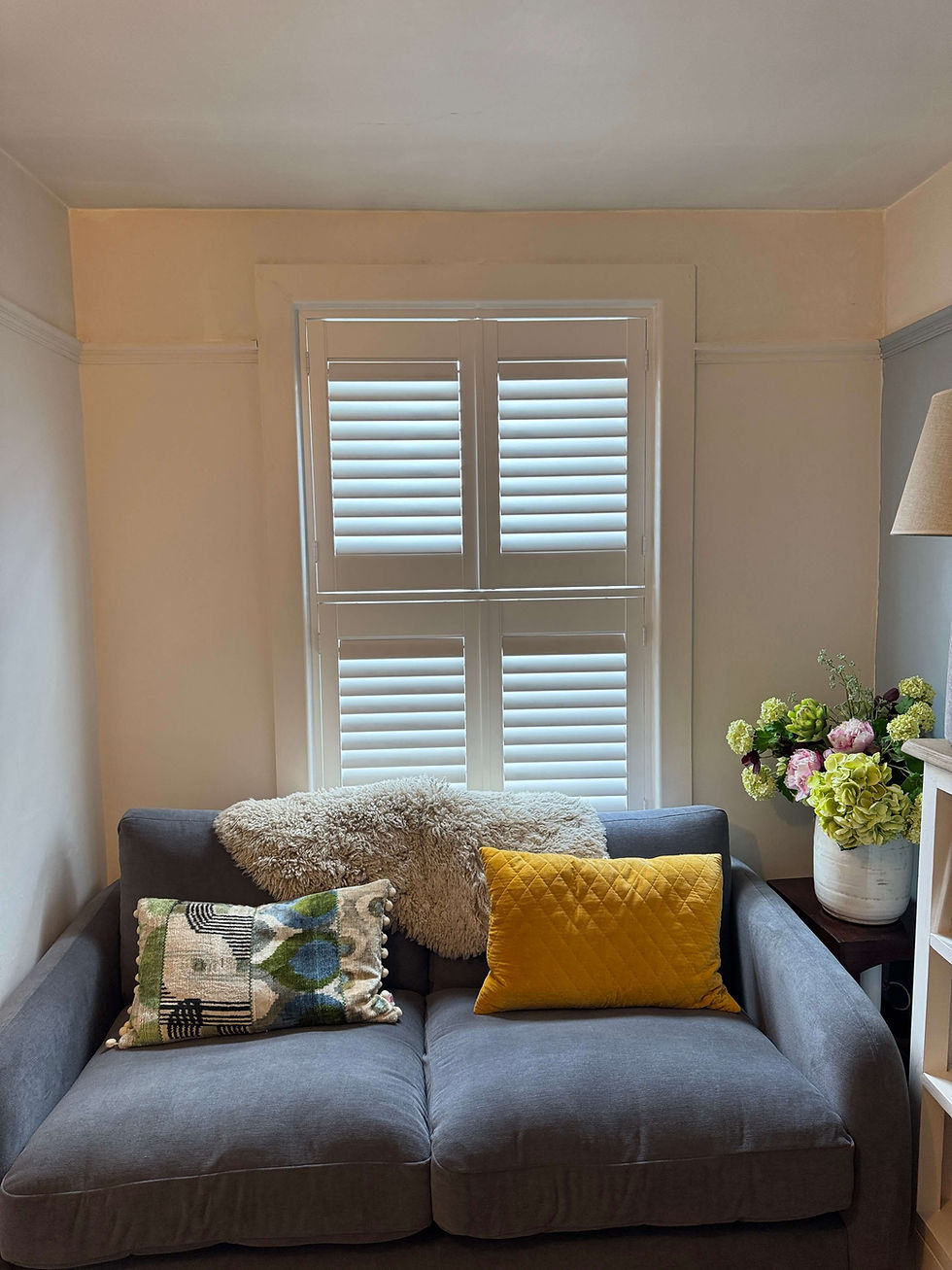
Tier-on-tier shutters are full height shutters divided horizontally into two independently operating sections — an upper tier and a lower tier. Each tier has its own set of panels and its own louvre rod, meaning the upper and lower sections can be opened, closed and adjusted completely independently of each other. The upper panels can be open for light while the lower panels are closed for privacy — or both open, both closed, or any combination of the two. We recently used a similar privacy split arrangement on a full height bay window installation in Bury St Edmunds.
How tier-on-tier shutters differ from full height shutters
Full height shutters run the entire height of the window as a single set of panels. When you open a full height shutter panel it reveals the whole window — top to bottom — and when you close it the whole window is covered. Louvre adjustment within a full height shutter applies to all the louvres on that panel simultaneously.
Tier-on-tier shutters divide the same window into two independent sections. The division point is typically at the meeting rail of a sash window — the horizontal bar where the upper and lower sashes meet — which is why tier-on-tier shutters suit Victorian, Georgian and Edwardian sash windows particularly well. The division coincides with an existing feature of the window rather than creating an arbitrary horizontal line across the glass.
The practical consequence of this independence is significant. With full height shutters, managing light and privacy requires a compromise — either the window is open for light and the room is visible from outside, or the window is covered for privacy and the room is darker. For a full comparison between cafe style vs full height shutters read our dedicated guide. With tier-on-tier shutters there is no compromise — the upper section can be open for maximum natural light while the lower section is closed against the street, or the louvres on the lower section can be adjusted to allow diffuse light while blocking the direct line of sight.
When are tier-on-tier shutters the right choice?
Tier-on-tier shutters are the right choice when both privacy and natural light are genuine priorities at the same window at the same time — a condition that applies in specific and common situations across Suffolk's housing stock.
Ground floor windows on busy streets — Properties in the town centres of Bury St Edmunds and Woodbridge where the living room or kitchen faces directly onto a pavement are the classic application. The lower panels closed against the street, the upper panels open to the sky — the room is bright and private simultaneously. For a full guide to managing privacy with shutters read our post on the best shutters for privacy.
Coastal footpath-facing properties — In Southwold, Aldeburgh and Walberswick where coastal footpaths run close to property facades, tier-on-tier shutters provide privacy from pedestrians in summer while maintaining the upper window view and natural light that are the primary reasons for owning a coastal property.
Bedroom windows where morning light matters — A bedroom window that receives early morning sun presents a familiar dilemma — you want to sleep past sunrise but you also want to wake to natural light rather than in total darkness. Tier-on-tier shutters with the upper panels slightly open on a tilt allow graduated natural light while the lower panels remain closed for privacy and light control.
Sash windows where both sashes are used — In properties where both sashes of a window are regularly opened for ventilation, tier-on-tier shutters allow the shutters to remain in position while each sash is opened independently — the upper shutter panels fold back when the upper sash is opened, the lower panels fold back when the lower sash is opened.
When full height shutters are not quite right — Some homeowners find that full height shutters on a ground floor window feel too exposed when fully open — opening the whole window from floor to top removes all privacy. Tier-on-tier shutters allow the upper section to be opened while the lower section remains as a privacy screen — a more comfortable middle ground for street-facing rooms.
Where tier-on-tier shutters are not the best choice
Tier-on-tier shutters are not always the right answer — and an honest guide should say so clearly.
They are more complex to manufacture than full height shutters and typically cost more — typically fifteen to twenty per cent more than full height shutters on the same window. If the additional flexibility of independent upper and lower operation is not something you will use regularly, the extra cost is not justified.
They are less appropriate for windows where the primary requirement is simply complete light control — a bedroom where you want blackout capability, for example. Full height shutters with all louvres closed provide equivalent blackout to tier-on-tier with both tiers closed, at lower cost.
They are also less visually clean than full height shutters from the exterior — the horizontal division between the two tiers is visible from outside and some homeowners prefer the unbroken appearance of full height shutters on their property facade. In a period property where the exterior appearance is important this is worth considering.
The honest summary is: tier-on-tier shutters are worth the additional cost when the independent operation will genuinely be used regularly — typically in ground floor rooms with street or footpath-facing windows. For upper floor rooms, secondary rooms and windows where privacy is not a daily concern, full height shutters are the better value choice.

Tier-on-tier shutters and sash windows
Tier-on-tier shutters and sash windows are natural companions — one of the most consistently successful combinations we produce across Suffolk. For everything you need to know about fitting shutters on sash windows read our complete sash window shutters guide.
The reason is the meeting rail. Every sash window has a horizontal bar at the midpoint of the window where the upper and lower sashes meet when both are closed. This meeting rail divides the window visually into upper and lower halves at exactly the point where a tier-on-tier shutter divides its two sections. The division between tiers aligns with an existing architectural feature of the window rather than imposing an arbitrary horizontal line across the glass.
The result is a shutter installation that looks like it was designed with the window rather than applied to it. The proportions feel correct, the horizontal division feels deliberate and the overall appearance is more architecturally coherent than tier-on-tier shutters on a window without this natural division point.
For Victorian sash windows in Bury St Edmunds and Woodbridge, Georgian sash windows in Lavenham and Edwardian sash windows in Southwold and Aldeburgh, tier-on-tier shutters specified to align with the meeting rail are one of the finest window treatments available.
Specifying tier-on-tier shutters correctly
The most important specification decision for tier-on-tier shutters — beyond the overall dimensions — is the position of the division between the upper and lower tiers.
In a sash window the division should align precisely with the meeting rail. This requires accurate measurement at the survey stage — the height of the meeting rail from the window sill is measured precisely and the shutter frame is specified so the tier division falls at exactly that point. A tier division that is even twenty millimetres above or below the meeting rail creates a visible misalignment that is immediately obvious to anyone looking at the window from inside or outside.
In casement windows or other window types without a natural meeting rail, the tier division is typically set at the midpoint of the window height — but this should be assessed at the survey stage based on the specific proportions of the window and the room.
The louvre size for tier-on-tier shutters follows the same principles as for any other style — proportionate to the window size and the scale of the room. In a sash window where each tier is effectively half the height of the full window, a forty-seven or sixty-three millimetre louvre typically suits the proportions of each tier better than a larger louvre that can look heavy in the reduced panel height. Read our full guide on how to choose the right louvre size for a complete breakdown.

Tier-on-tier shutters in coastal Suffolk properties
The privacy argument for tier-on-tier shutters is particularly strong in coastal Suffolk where the combination of beautiful sea views and public coastal footpaths creates a daily tension between openness and privacy.
A seafront property in Southwold or Aldeburgh bought for its sea view presents a familiar challenge — the view is the reason you live there, but the footpath that makes the seafront accessible to everyone also runs close to your windows. Full height shutters solve the privacy problem but at the cost of the view. Tier-on-tier shutters maintain the upper window view while the lower panels provide privacy from the footpath — the view and the privacy coexisting in the same window.
This is genuinely one of the most compelling applications of tier-on-tier shutters in the Suffolk context and it is an argument we make at almost every coastal survey we carry out. Read our full guide to shutters for seaside homes in Suffolk for the complete coastal picture. For coastal homeowners who have been compromising between view and privacy for years, tier-on-tier shutters are often the solution they did not know was available.
What do tier-on-tier shutters cost?
Tier-on-tier shutters cost more than full height shutters on the same window — the additional complexity of the independent tier mechanism and the doubled panel count increases both material and manufacturing cost.
As a general guide for Suffolk properties:
Standard Victorian or Georgian sash window, tier-on-tier £220 — £340 fitted in hardwood
Larger sash window, tier-on-tier £280 — £420 fitted
Edwardian wider sash window, tier-on-tier £260 — £380 fitted
The premium over full height shutters on the same window is typically between fifteen and twenty-five per cent. For ground floor street-facing or coastal footpath-facing windows where the independent operation will be used every day, this premium is consistently considered worthwhile by the homeowners who choose it.
A free home survey from Miavalentina Interiors covers Southwold, Aldeburgh, Woodbridge, Bury St Edmunds, Walberswick and Lavenham at a time that suits you including evenings and weekends.

If you have ground floor windows facing a street or coastal footpath and you would like to find out whether tier-on-tier shutters are the right solution, book your free survey here. We will assess your specific windows honestly and give you our recommendation — including when full height shutters are the better choice.


Bài viết của bạn gọn gàng, mạch lạc nên mình đọc một lượt là nắm được ý chính, cảm ơn bạn đã bỏ công chia sẻ. Mình cũng có thói quen xem thống kê XSMB mỗi ngày, nhưng hồi trước phải lục nhiều nơi khác nhau nên khá mất thời gian. Về sau mình tự gom lại để tiện tra nhanh, kiểu lưu một chỗ cho đỡ rối, lúc cần thì mở ra xem lại. Thỉnh thoảng mình cũng đối chiếu thêm trên soicau247.com để khỏi phải nhớ quá nhiều nguồn và đỡ sót thông tin. Bạn nào cũng hay cập nhật số liệu theo ngày giống mình thì có thể xem thêm ở đây: https://soicau247.com/soi-cau-song-thu-de.html.